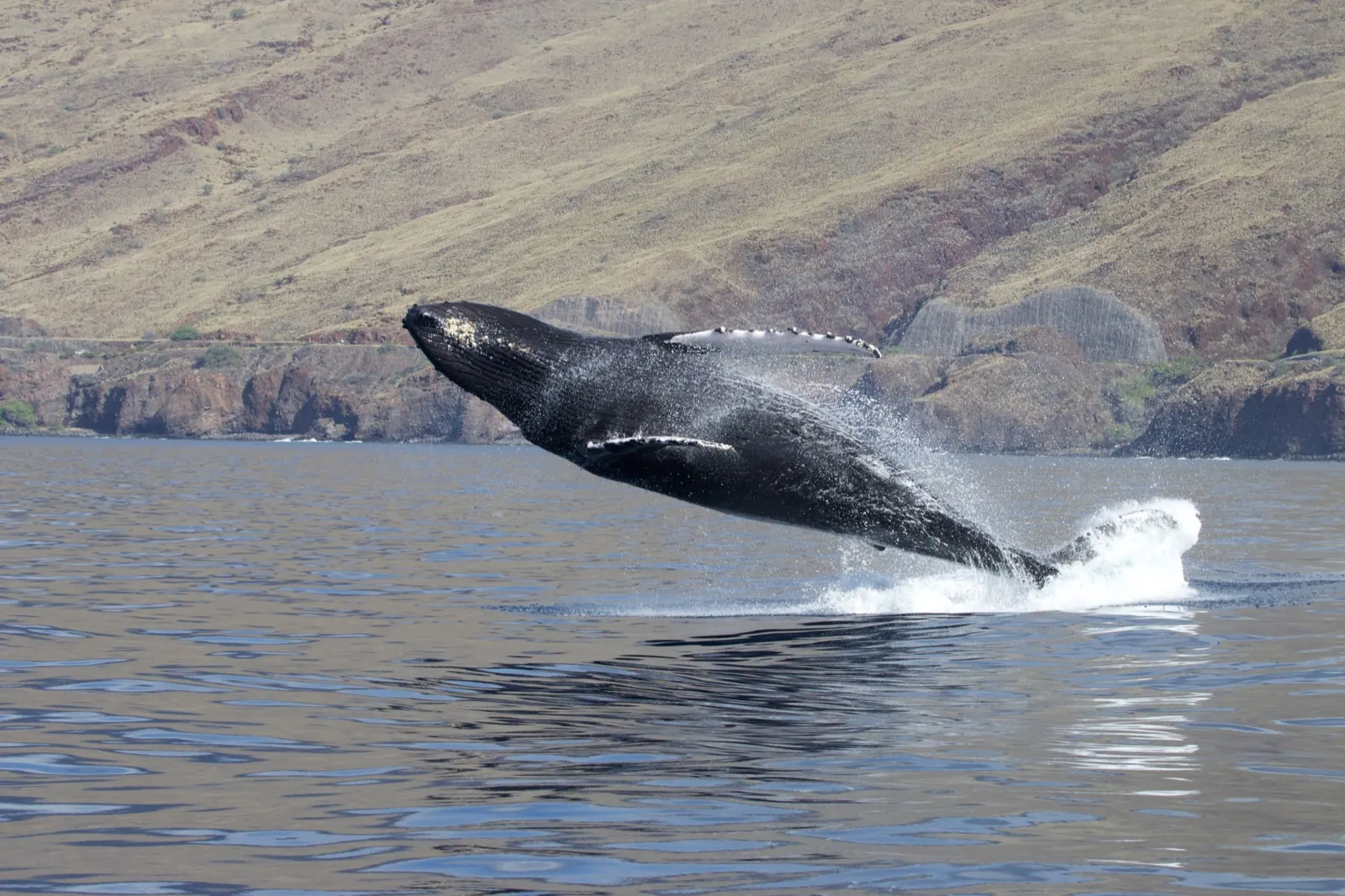
A humpback whale breaching in front of the dry West Maui cliffs near Papawai Point
  • Maui whale season
  • Nov
  • Dec
  • Jan
  • Feb
  • Mar
  • Apr
  • May

Whale watching in West Maui

Every winter more than 10,000 North Pacific humpbacks swim 3,000 miles from Alaska to the warm, shallow water between Lahaina and Lānaʻi. This is the guide to when they come, why they come, what they are doing out there, and the best ways to see them from the shore or the water.

Photo: HIHWNMS / NOAA
10,000+humpbacks winter in Hawaiʻi, more than half of the North Pacific population
3,000 mifrom the Alaska feeding grounds to Maui, swum in as little as 28 days
Dec–Aprwhale season, with the January–March peak and February usually the busiest
40 tonsa full-grown adult, up to 60 feet long. Calves are born 13 to 16 feet
100 ydthe federal minimum distance for boats, kayaks and swimmers
Whale season

When to see whales on Maui

Whale season starts in December. The channel fills through the month, January through March is peak, April is the quiet tail, and the last mothers and calves leave in May.

The best single month is February, but if you want a quieter channel and warmer, calmer water, late March and April are underrated. Read the month-by-month guide →

Best boat tours in West Maui

Two very different ways to meet a whale

A small raft that sits at eye level with the water, or a premium catamaran with lunch and an open bar. Both load from Kāʻanapali Beach, both guarantee sightings, and we have been on both.

Guests on the Maui Whale Adventures raft watching a humpback surface a few yards off the bowSmall group · eye level

Maui Whale Adventures

A fast, shaded twin-engine adventure raft that loads straight off the sand at Kāʻanapali Beach. Twenty guests max, a certified naturalist and a hydrophone on every trip, and you sit a few feet above the water. The closest you can legally get to a whale.

  • Trip2 hours, up to 20 guests
  • DepartsKāʻanapali Beach, behind Whalers Village
  • SeasonDec 1 – Apr 30 · first trip 7:00 AM
  • GuaranteeSee whales or go again free
from$79per guest · private charters from $1,350

★★★★★ 4.9 from 250+ Google and Tripadvisor reviews

Kāʻanapali Beach at Black Rock, where the Teralani catamarans beach-load their guestsPremium · large catamaran

Teralani Premium Whale Watch

Teralani's flagship 2.5-hour whale watch on a custom-built sailing catamaran from Kāʻanapali Beach, with a chef-prepared island lunch, full open bar, marine naturalist, hydrophone and wide viewing decks and nets. Limited to 35 guests on a boat that normally carries far more, so there is room at the rail for everyone.

  • Trip2.5 hours, up to 35 guests
  • DepartsKāʻanapali Beach, 12:30 PM (check-in noon)
  • SeasonNov 1 – Apr 15 · daily
  • GuaranteeSee whales or a free Classic whale watch
from$154.95per person · kids 5 and under free

★★★★★ 4.9 from 2,100+ verified guest reviews

Compare the two tours in detail

Migration

Alaska to Maui, every winter, on an empty stomach

Maui's humpbacks spend the summer gorging on krill and herring from British Columbia to the Bering Sea. Then they stop eating and swim roughly 3,000 miles to breed and give birth in the shallow, predator-free water around Maui Nui.

Map of the North Pacific humpback whale migration from Alaska and British Columbia to Maui, Hawaiʻi Humpback whales feed in summer off Southeast Alaska, the Gulf of Alaska, the Aleutian Islands and British Columbia, then swim roughly 3,000 miles to the shallow, warm waters around Maui to breed and calve each winter. Southeast AlaskaGlacier Bay · Frederick Sound Gulf of AlaskaPrince William Sound · Kodiak Aleutian Islands & Bering SeaUnimak Pass British ColumbiaNorthern BC coast Maui, HawaiʻiWinter breeding & calving grounds≈ 3,000 miles4–8 weeks each way, no feeding North Pacific humpback migration Southbound Oct–Jan · Northbound Mar–May Summer feeding grounds Winter breeding grounds (Hawaiʻi) Coastlines: Natural Earth · Routes are schematic great-circle paths

How they navigate, how long it takes, and why Maui →

Surface behaviors

What you are actually seeing

Humpbacks are the most acrobatic of the great whales. Each move has a name and, usually, a meaning.

A humpback whale surfacing with a tall misty blow rising above its back
Breathing

Blow (spout)

The first thing most people see. A humpback exhales about 90 percent of its lung volume in a fraction of a second, and the warm, oily breath condenses into a bushy column...

A humpback whale launching most of its body out of the water off Maui, long white pectoral fin extended
Communication · display · play

Breach

The showstopper. A 40-ton whale drives upward with two or three powerful tail strokes and clears most of its body before crashing back on its side. The slap carries for...

A humpback whale rolled on its side with one long white pectoral fin raised high above the water
Signalling · courtship

Pectoral slap

Humpback flippers are the longest of any whale, up to 15 feet, a third of the body. Rolling on its side or back, the whale lifts one or both and slaps them flat on the...

A humpback whale's flukes raised high before slapping down on the sea surface
Warning · annoyance

Tail slap (lobtail)

The whale hangs head-down, raises its flukes high and smacks them down, over and over. Where a breach says hello, a tail slap often says back off. Mothers lobtail when...

A humpback whale throwing its tail stock and flukes sideways out of the water in a sheet of spray off Maui
Aggression

Peduncle throw

The most violent thing a humpback does at the surface. It whips the whole rear third of its body, the peduncle, sideways out of the water and slams it down on, or at,...

A humpback whale driving its head and pleated throat up and forward out of the water off Maui
Assertion · pursuit

Head lunge

A surging push of the head above the surface, throat pleats showing, usually at speed and straight at a rival. Head lunges are the stuff of Maui's competition pods: a...

All ten behaviors, explained

The paved lookout at Papawai Point above the ʻAuʻau Channel, with Māʻalaea Bay beyond
Papawai Point lookout, Honoapiʻilani Highway. Photo: Luke H. Gordon, CC BY 2.0
Free

Whale watching from shore

The stretch of Honoapiʻilani Highway between Māʻalaea and Lahaina is one of the best places in the world to watch whales without a boat. In peak season you will see blows from your car.

We map ten lookouts from Papawai Point to Honolua Bay, with parking notes and the best time of day for each. See the shore map →

Quick answers

Frequently asked

When is whale season on Maui?

Maui whale season runs December through April. Peak season, when the ʻAuʻau Channel holds the most whales, is January through March. A few early whales show up in October and November and a few mothers and calves linger into May, but December is when the season really starts and the boats are out every day. West Maui tours run through mid or late April.

What is the best month to see whales in Maui?

February. It has the highest counts in almost every year of the Great Whale Count and Sanctuary Ocean Count, and it is the month of World Whale Day on Maui. January and March are nearly as good. If you want fewer boats and calmer seas, late March and April are quieter but still full of mothers and calves.

Can you see whales from shore in Maui?

Yes, easily, and West Maui is the best place on the island for it. The lookouts along the Honoapiʻilani Highway between Māʻalaea and Lahaina (Papawai Point and McGregor Point) sit high above the channel where the whales concentrate. Kāʻanapali Beach and the Kapalua Coastal Trail are also reliable in peak season. Bring binoculars and go in the morning when the water is glassy.

Where do whale watching boats leave from in West Maui?

Most leave right off the sand at Kāʻanapali Beach, in front of Whalers Village, where a shuttle or the boat itself noses onto the beach. Mala Boat Ramp in north Lahaina is the other West Maui launch. Lahaina Harbor reopened for limited daytime commercial use in December 2025 after the 2023 fire, and a few operators have returned, but most West Maui whale watches still load at Kāʻanapali or Mala.

Is a small raft or a big catamaran better for whale watching?

It depends on your group. A raft like Maui Whale Adventures’ twin-engine adventure boat puts you a few feet above the water with 20 or fewer people, covers more water quickly, and is the pick for photographers and anyone who wants to be close. A catamaran like Teralani’s gives you a stable, shaded deck, a bathroom, lunch and an open bar, and is the better choice for grandparents, toddlers, and people who get seasick. Both run naturalists and hydrophones and both guarantee sightings.

How close can boats get to the whales?

Federal law makes it illegal to approach a humpback whale closer than 100 yards (300 feet) in Hawaiian waters, by boat, kayak, paddleboard or swimming, and 1,000 feet by aircraft. Whales, however, can approach you. When a curious whale surfaces next to a boat the captain puts the engines in neutral and waits, and these muggings are the encounters people remember for life.

All questions →

Ready to get on the water?

Both operators load from the sand at Kāʻanapali Beach, run certified naturalists and hydrophones, and guarantee you will see whales. Pick the one that fits your group.

Maui Whale Adventures

20-guest raft, eye level with the water, 2 hours, from $79. Best for photographers, families with older kids and anyone who wants to be close.

Book at MauiWhaleAdventures.com

Teralani Premium Whale Watch

35-guest sailing catamaran, lunch and open bar, 2.5 hours, from $154.95. Best for groups, grandparents, and anyone who wants comfort with their whales.

Check dates & book